History
A short history of the art
From the variety shows of the Qin and Han to Tang court displays, Ming stages and today's provincial troupes, with a stop in Wuqiao.
Book the acrobatics hour ↗Quick answer
Chinese acrobatics is more than two thousand years old. Wikipedia traces variety shows to the Qin dynasty or earlier, describes elaborate court performances under the Han and Tang, and notes that performers moved from street to stage towards the end of the Ming. After 1949, provincial troupes were founded across China, and in the 1990s the acts were first packaged as complete theme shows.
Qin and Han beginnings
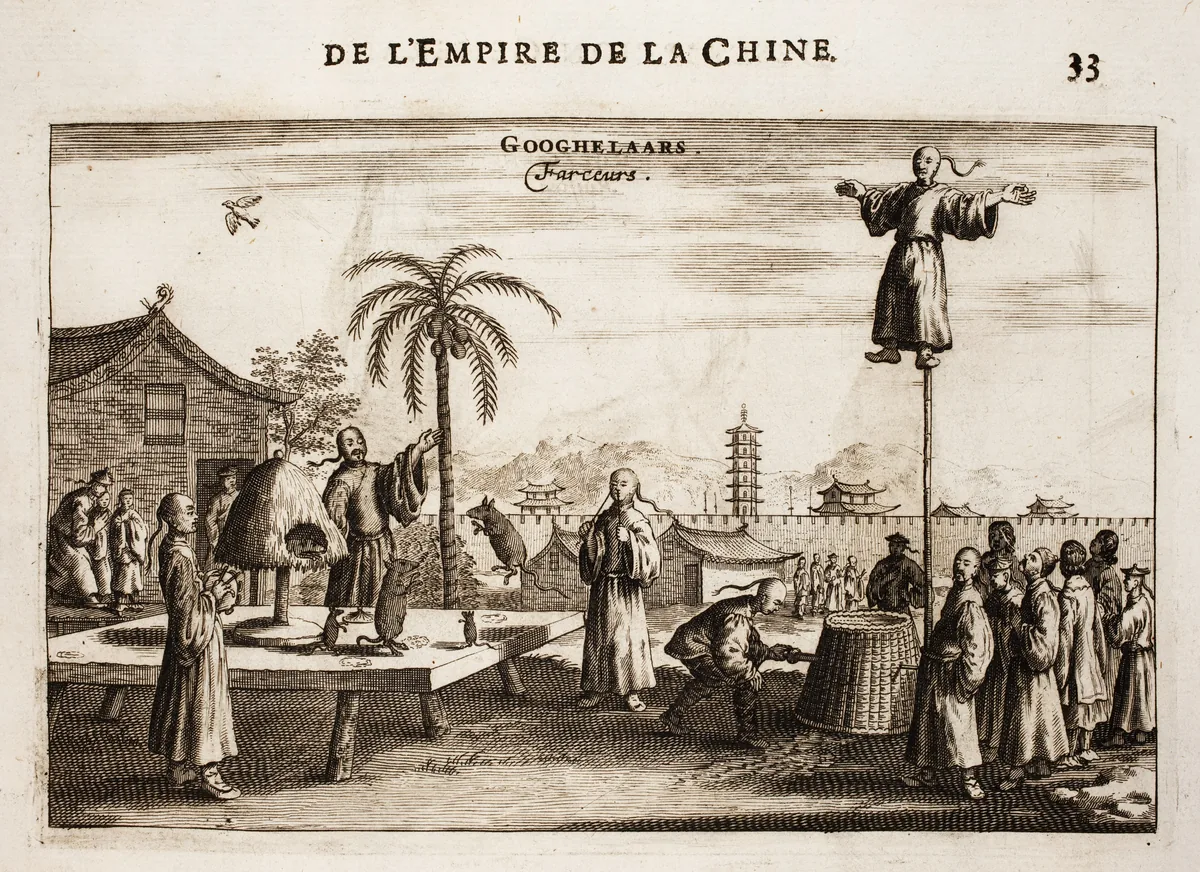
Wikipedia says variety shows existed as early as the Qin dynasty, 221 to 207 BC, or possibly earlier. Under the Qin and Han, a form called juedi or baixi was popular with ordinary people. Juedi began as men wearing horns charging at one another like bulls, then became a general term for entertainment that mixed conjuring, acrobatics, wrestling, music, dance, martial arts, horsemanship and juggling.
A poet at the palace
In the Eastern Han, the scholar Zhang Heng was one of the first to describe acrobatic theme shows in the royal palaces, in his Ode to the Western Capital, Wikipedia notes. He wrote of knife swallowing and fire spitting, of creatures that transformed into others, and of children performing acrobatics on high poles. Wikipedia adds that Emperor Wu of Han staged a grand acrobatic show for foreign guests in 108 BC.
Tang court and Song tiles
Performances grew more refined under the Tang, from 618 to 907, when the art was popular at the emperor's court. Wikipedia's Acrobatics article adds that acrobatics were part of village harvest festivals in China. Later the art lost favour at court and returned to the streets. Under the Song, variety shows could be seen in entertainment centres called wazi, a word meaning tiles.
From street to stage
Towards the end of the Ming dynasty, performers came off the street and began performing on stage, says Wikipedia, and at the end of the Qing the art regained popularity at the imperial court. It has remained popular ever since. The diabolo, or Chinese yo-yo, belongs to this period too: its earliest written mention dates to the late Ming.
Wuqiao, home of acrobatics
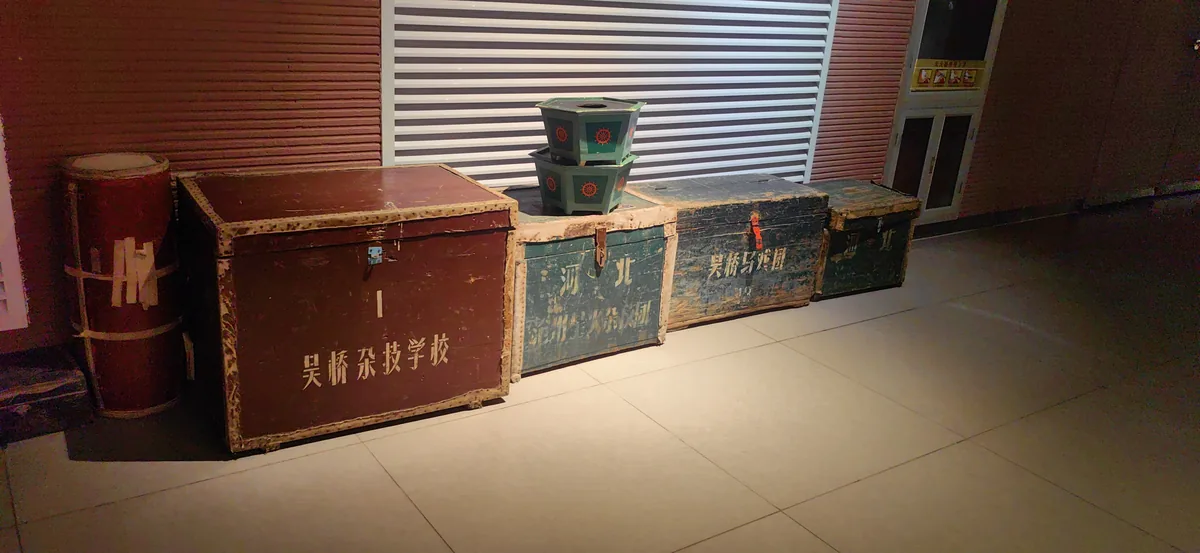
Wuqiao County, in south-eastern Hebei, has a special place in the story. Wikipedia says tomb murals from the Eastern Wei dynasty, unearthed there in 1958, show handstands, plate spinning and horsemanship, and that Wuqiao acrobatics grew in reputation after the Yuan moved the capital to Beijing. Wuqiao performers joined troupes across China and abroad, and Premier Zhou Enlai called the county the home of Chinese acrobatics.
After 1949
Since the founding of the People's Republic in 1949, Wikipedia says, the art has gained new respectability. Troupes were established in the provinces, autonomous regions and municipalities, with theatres dedicated to the variety arts, and some troupes became world famous, playing to packed houses at home and on foreign tours. The troupe that performs the one-hour show in Dongcheng comes from Suining, a city in eastern Sichuan.
The theme show
Only in the 1990s, Wikipedia notes, was the art packaged as a complete theme show; the 1994 production Golden Wind of the Southwest led the way. Earlier evenings strung separate acts together; a theme show wraps them in one title and one production. The one-hour show in Dongcheng follows that model, with a title and a troupe identity, while keeping the old disciplines at its core.
What it means for your evening
Knowing the history changes how you watch. The plates, the hoops and the poles are not modern inventions dressed up for tourists but skills with a written record going back to the Han, refined in court and street for centuries. When an act ends on a balance that seems to go one step too far, you are watching a very old idea: that skill itself is the show.
Frequently asked questions
How old is Chinese acrobatics?
Wikipedia traces variety shows to the Qin dynasty, 221 to 207 BC, or possibly earlier.
What is Wuqiao?
A county in Hebei that Premier Zhou Enlai called the home of Chinese acrobatics; its performers work in troupes across China and abroad.
When did theme shows begin?
In the 1990s; Wikipedia credits the 1994 show Golden Wind of the Southwest with leading the way.
Sources